
Guide / SELECTED VINTAGE GUITARS
Fender Japan Serial Numbers: MIJ, CIJ, JV & JD Guide
Read your Fender Japan serial number, compare Made in Japan and Crafted in Japan markings, and find a possible production period. See photographs from our catalogue and open the serial number decoder.
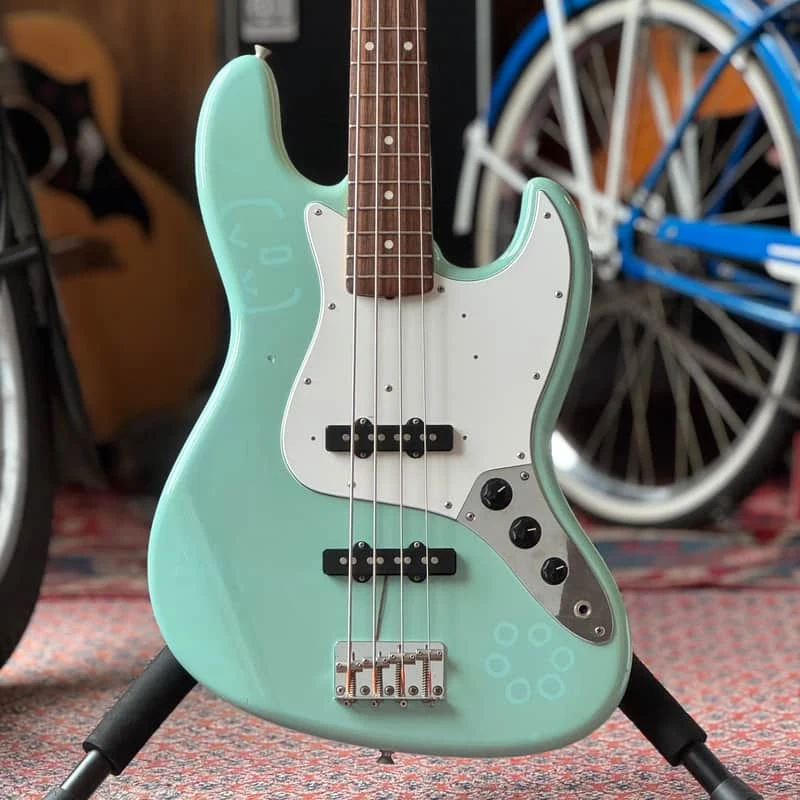
How to check a Fender Japan serial number
Copy the complete serial, including its prefix, and count the digits. Read the Made in Japan (MIJ) or Crafted in Japan (CIJ) wording as well: include it when using the decoder. Compare the result with the model, construction and available records. If the wording is illegible, select the uncertain option rather than guessing.
The decoder linked above also covers selected Fender formats from the USA, Mexico, Korea and Indonesia. This guide focuses on Japan: where to find the markings, why MIJ and CIJ matter, and how to interpret examples.
Where is the serial: headstock, neck heel or neck plate?
Inspect both sides of the headstock, the back of the neck near the body, and the metal neck plate. The location varies by model and period; a headstock without a serial does not mean the instrument has none. The photographs below show the same Daphne Blue Fender Jazz Bass JB62 from the Selected Vintage Guitars catalogue.
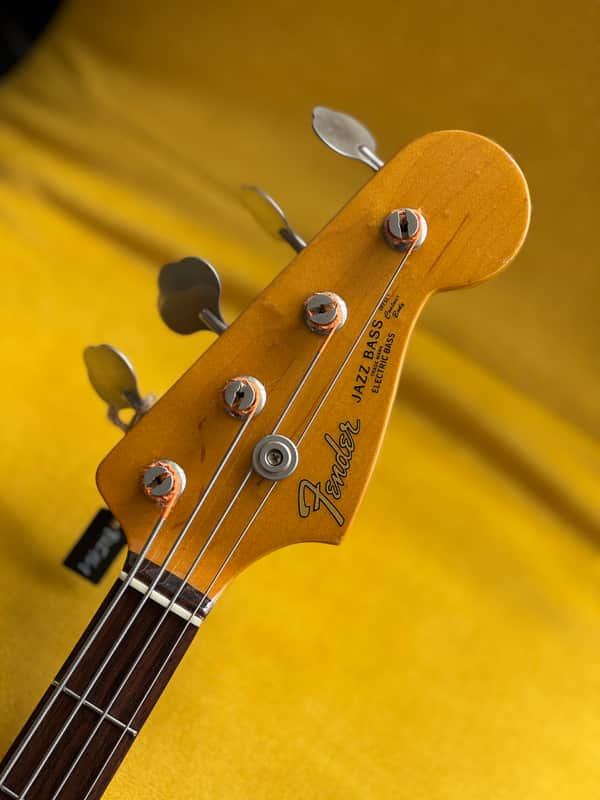
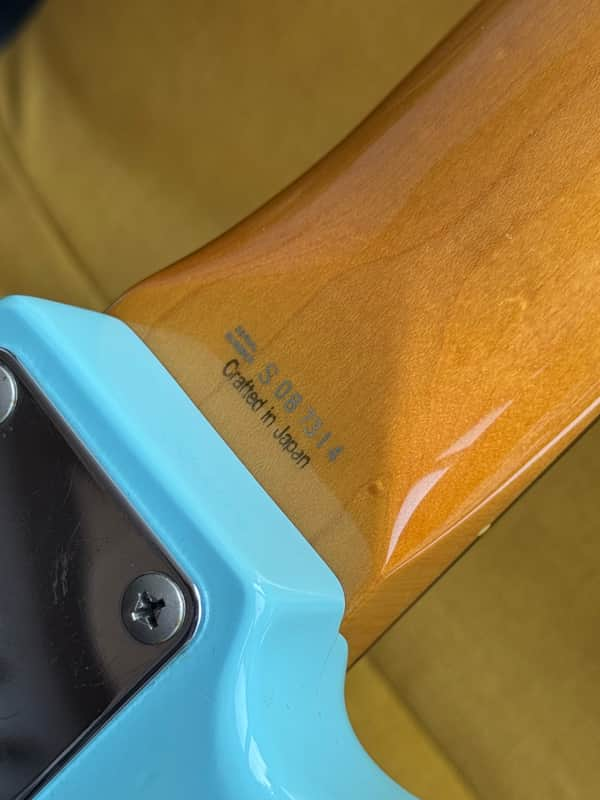
An example from our catalogue: a Crafted in Japan Jazz Bass JB62
The neck-heel photograph shows Crafted in Japan and a serial beginning with S. Fender’s table places CIJ S followed by six digits in 2006–2008, which is also the period given for this example in our catalogue. The serial alone does not select one year within that range.
Before using a decoder, read the serial and the wording from the same instrument instead of relying only on a listing title. These photographs remain useful reference material even after the instrument is sold.
Fender — official Japanese instrument dating guide ↗
View this Jazz Bass JB62 and its photographs ↗
MIJ vs CIJ: the same letter can mean a different period
Made in Japan and Crafted in Japan are dating inputs, not quality grades. For example, S followed by six digits with MIJ appears under 1994–1995 in the older table, while CIJ S points to 2006–2008. Without the accompanying wording, choosing the later period would be a guess.
Crafted in Japan appeared in 1997. Made in Japan returned from 2007, with both markings used in 2007–2008. MIJ T has earlier and later ranges, so model features also matter. This table presents selected formats, not a complete register of every Fender.
Fender — official Japanese instrument dating guide ↗
| Marking | Prefix + digit count | Date range |
|---|---|---|
| Made in Japan | JV + 5 | 1982–1984 |
| Made in Japan | SQ + 5 | 1983–1984 |
| Made in Japan | E + 6 | 1984–1987 |
| Made in Japan | S / T + 6 | 1994–1995 |
| Crafted in Japan | S + 6 | 2006–2008 |
| Crafted in Japan | T + 6 | 2007–2008 |
| Made in Japan | T + 6 | 2007–2010* |
Fender — official Japanese instrument dating guide ↗
JV, SQ, E and JD: what does the prefix tell you?
JV, SQ and E lead to the ranges shown in the table. JD uses a different scheme: eight digits follow the prefix and the first two indicate the year. The invented example JD12000001 illustrates 2012; it is not a serial from our stock.
The asterisk against MIJ T means selected models retained that format through 2011. Fender also identifies some U-plus-six-digit instruments from the 2012 transition. Compare any range with the specification instead of treating it as an exact completion date.
Fender — official Japanese instrument dating guide ↗
Does MIJ or CIJ identify the factory?
The wording alone does not establish the factory of an individual instrument. Fujigen records the start of production for CBS Fender in April 1982, but that historical fact does not identify every later Japanese Fender. We do not automatically assign MIJ to one factory and CIJ to another.
Fujigen — official company history ↗
No match, or more than one possible date?
Check zero versus the letter O and make sure every digit is present. A missing match does not prove a counterfeit, and a valid format does not authenticate an instrument. Parts and markings may have been replaced, so the whole instrument matters.
For help, email shop@selectedvintageguitars.com with clear photographs of both sides of the headstock, the whole guitar or bass, the serial and country marking. Include the model and any known repair history. We can compare the markings with the instrument’s features and suggest what to check next. Do not remove the neck solely to obtain a photograph.
Email us photographs for identification ↗
Browse current Fender Japan instruments ↗
Try the Fender serial number decoder: USA, Japan, Mexico, Korea and Indonesia ↗