
Guide / GUITAR LAB
An acoustic soundboard crack: assessment and repair planning. Mountain W350
A visible line does not tell the whole story of a guitar’s body. We explain how to assess soundboard damage and plan service for an older acoustic.
First establish what is damaged
A visible line may be finish damage or a crack in the wood. Its location, the condition of its edges and the area inside the body all matter to the repair plan. A photograph from above may not be enough to assess them.
Not every gap should immediately be filled with glue. Diagnosis comes first, so the repair can suit that particular soundboard. The gluing method and any reinforcement are chosen after inspecting the damage.
Humidity is part of the condition assessment
Dry conditions can make wood shrink and crack, and can change body geometry and action. Storage conditions therefore deserve attention when a soundboard is damaged. Information about where the guitar was kept and any recent environmental changes complements the inspection.
This does not mean every crack was caused by dry air. Do not determine the cause simply because it resembles another guitar in a photograph. Monitoring storage conditions after repair is useful, but does not replace assessment of the repaired joint.
Mountain W350: more than a soundboard repair
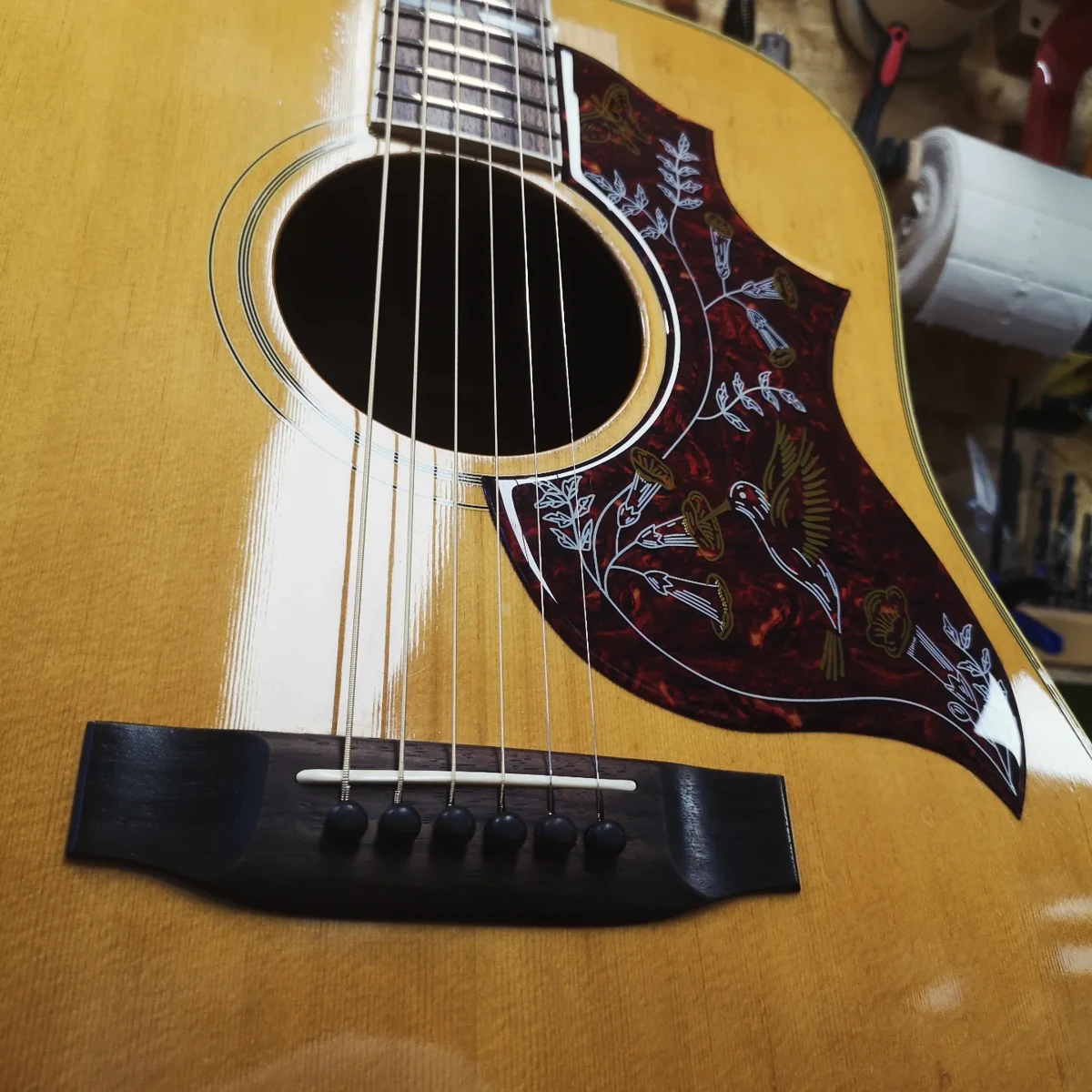
On this Mountain W350 we repaired a soundboard crack, levelled the fingerboard and replaced the frets. The guitar received a bone nut and bone saddle. We also installed a new pickguard and serviced the hardware.
The work combined body repair with preparation of the neck and string-support components. On an older acoustic, these areas are worth considering together even when a single visible fault prompted the visit.
A nut must fit the instrument
A bone nut needs fitting to its slot and the string spacing. The width and depth of its grooves should suit the intended strings. Final height is checked with the strings installed and tuned. The material itself cannot replace correct workmanship.
Before visiting the workshop
Photograph the whole instrument and take a close-up of the damage. Note when you noticed it and whether playability changed. Describe any previous repairs you know about. This information helps prepare the condition assessment.
Further reading
For a better understanding of humidity and acoustic guitars, see Taylor’s technical sheet. The StewMac resource adds a practical explanation of nut making.