
Acoustic / Morris
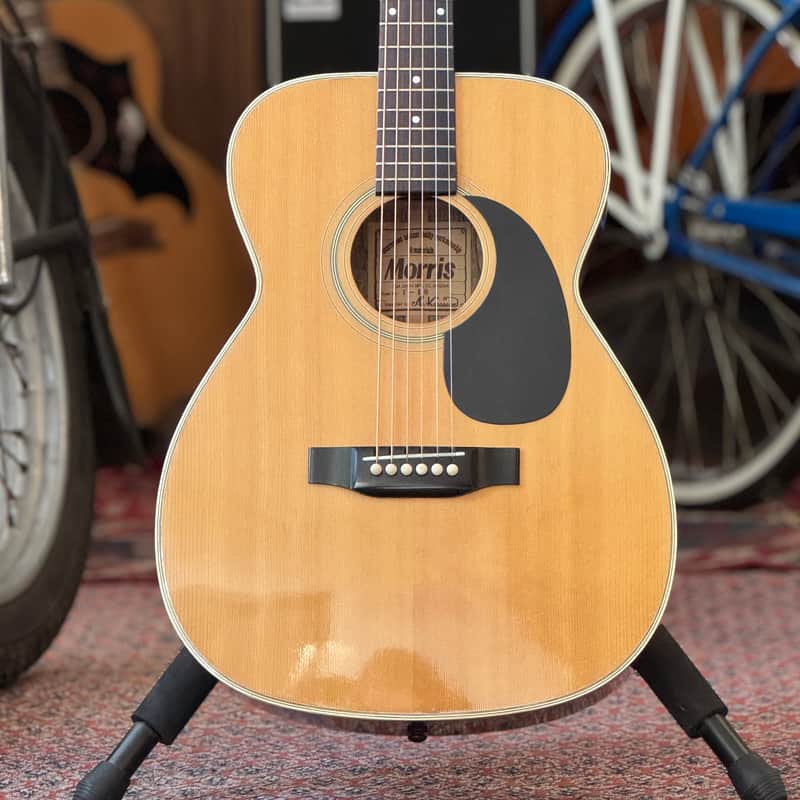
Morris F-18 – Natural, Early Vintage, 1973
Listed on Reverb
699.00 EUR
Original Reverb prices in EUR. Check the listing for shipping and the final total.
- Model
- F-28
- Year
- 1973
- Finish
- Natural
About this instrument
Instrument description in English.
Morris F-18 is a Japanese Folk-style acoustic guitar, manufactured in 1973 at the Moridaira Gakki factory. The instrument features a soundbox with a spruce top plate and rosewood back and sides. The Folk shape is characterized by a narrower waist than a traditional Dreadnought. After our service work, which included fingerboard leveling, refretting, bridge ramping, and crafting natural bone nuts, the guitar is ready to play.
Technical specification
Manufacturer: Morris
Model: F-18
Year of production: 1973
Body: Spruce / Rosewood
Neck: Nato
Fingerboard: Rosewood
Frets: Medium (Condition: 100% – new)
Pickups: None
Electronics: None
Visual condition: Visible signs of use (details in description)
Finish: Natural
Weight: 1.73 kg / 3.81 lbs
Body and construction The Folk-shaped soundbox features a narrower waist and a shallower depth compared to standard models. The top plate is made of spruce, while the back and sides are made of rosewood. The instrument is finished with a clear lacquer. A traditional Set-Neck construction is used. In our workshop, the lacquer coating went through a cleaning and waxing process.
Neck and ergonomics The Nato wood neck features a profile similar to a "C" shape. The width at the nut is 42 mm. The neck is paired with a rosewood fingerboard. As part of the service work, the old frets were removed, the fingerboard was leveled, and brand new Blacksmith frets (2.1 mm) were installed. A new nut made of natural bone was also fitted. The fingerboard surface was cleaned and conditioned.
Sound The instrument is a fully acoustic guitar with no electronic circuit.
Characteristics: The use of a spruce top and rosewood back and sides in a Folk body, despite its smaller dimensions, generates a dynamic sound with a clear, strong bass and a selective mid-range.
Dynamics: The guitar responds appropriately to varied articulation strength, maintaining frequency clarity during both fingerstyle playing and strumming with a pick.
Additional information
The Morris brand name originates from the nickname "Mori", given to the company's founder, Toshio Moridaira, during his visit to the American Gibson factory in 1964.
The F-18 model is based on a Folk body (similar to the 000/OM size), which, despite its smaller dimensions, supports the low-end frequencies thanks to the use of rosewood.
The procedure of routing slots in the bridge (ramping) allows for maintaining the proper string break angle (pressure) on the saddle while lowering the string action.
The service work we performed included: fingerboard leveling, complete refretting, crafting a bone nut and saddle, bridge ramping, and setting the string action.
Hardware
Bridge: Rosewood – the bridge features a custom-made saddle crafted from natural bone in our workshop. Professional slot routing (ramping) was also performed.
Tuners: Closed-gear, oil-sealed Gotoh mechanisms. The chrome hardware went through a cleaning process and retains its mechanical efficiency.
Instrument condition
Technical condition: The instrument is mechanically functional after a luthier verification. The truss rod works properly, and the frets are brand new.
Visual condition: The guitar shows signs of use appropriate for its age. Minor dings and scratches are visible on the lacquer coating. The instrument has no structural wood cracks.
Setup and Modifications: Refretting (Blacksmith), crafting of bone nuts, fingerboard leveling, bridge ramping, and a setup of the string action were performed.
Why choose this instrument
Rosewood tone: The use of this wood species for the back and sides of the body supports the generation of a stronger bass in a smaller instrument.
New frets and leveling: The complete replacement of frets and fingerboard leveling eliminate the wear resulting from use and ensure proper intonation.
Bridge ramping: The ramping modification improves the transfer of string energy to the soundbox.
Ready to play: After our service work, the guitar is fully prepared for regular playing without the need for additional luthier visits.
Technical specification
Manufacturer: Morris
Model: F-18
Year of production: 1973
Body: Spruce / Rosewood
Neck: Nato
Fingerboard: Rosewood
Frets: Medium (Condition: 100% – new)
Pickups: None
Electronics: None
Visual condition: Visible signs of use (details in description)
Finish: Natural
Weight: 1.73 kg / 3.81 lbs
Body and construction The Folk-shaped soundbox features a narrower waist and a shallower depth compared to standard models. The top plate is made of spruce, while the back and sides are made of rosewood. The instrument is finished with a clear lacquer. A traditional Set-Neck construction is used. In our workshop, the lacquer coating went through a cleaning and waxing process.
Neck and ergonomics The Nato wood neck features a profile similar to a "C" shape. The width at the nut is 42 mm. The neck is paired with a rosewood fingerboard. As part of the service work, the old frets were removed, the fingerboard was leveled, and brand new Blacksmith frets (2.1 mm) were installed. A new nut made of natural bone was also fitted. The fingerboard surface was cleaned and conditioned.
Sound The instrument is a fully acoustic guitar with no electronic circuit.
Characteristics: The use of a spruce top and rosewood back and sides in a Folk body, despite its smaller dimensions, generates a dynamic sound with a clear, strong bass and a selective mid-range.
Dynamics: The guitar responds appropriately to varied articulation strength, maintaining frequency clarity during both fingerstyle playing and strumming with a pick.
Additional information
The Morris brand name originates from the nickname "Mori", given to the company's founder, Toshio Moridaira, during his visit to the American Gibson factory in 1964.
The F-18 model is based on a Folk body (similar to the 000/OM size), which, despite its smaller dimensions, supports the low-end frequencies thanks to the use of rosewood.
The procedure of routing slots in the bridge (ramping) allows for maintaining the proper string break angle (pressure) on the saddle while lowering the string action.
The service work we performed included: fingerboard leveling, complete refretting, crafting a bone nut and saddle, bridge ramping, and setting the string action.
Hardware
Bridge: Rosewood – the bridge features a custom-made saddle crafted from natural bone in our workshop. Professional slot routing (ramping) was also performed.
Tuners: Closed-gear, oil-sealed Gotoh mechanisms. The chrome hardware went through a cleaning process and retains its mechanical efficiency.
Instrument condition
Technical condition: The instrument is mechanically functional after a luthier verification. The truss rod works properly, and the frets are brand new.
Visual condition: The guitar shows signs of use appropriate for its age. Minor dings and scratches are visible on the lacquer coating. The instrument has no structural wood cracks.
Setup and Modifications: Refretting (Blacksmith), crafting of bone nuts, fingerboard leveling, bridge ramping, and a setup of the string action were performed.
Why choose this instrument
Rosewood tone: The use of this wood species for the back and sides of the body supports the generation of a stronger bass in a smaller instrument.
New frets and leveling: The complete replacement of frets and fingerboard leveling eliminate the wear resulting from use and ensure proper intonation.
Bridge ramping: The ramping modification improves the transfer of string energy to the soundbox.
Ready to play: After our service work, the guitar is fully prepared for regular playing without the need for additional luthier visits.